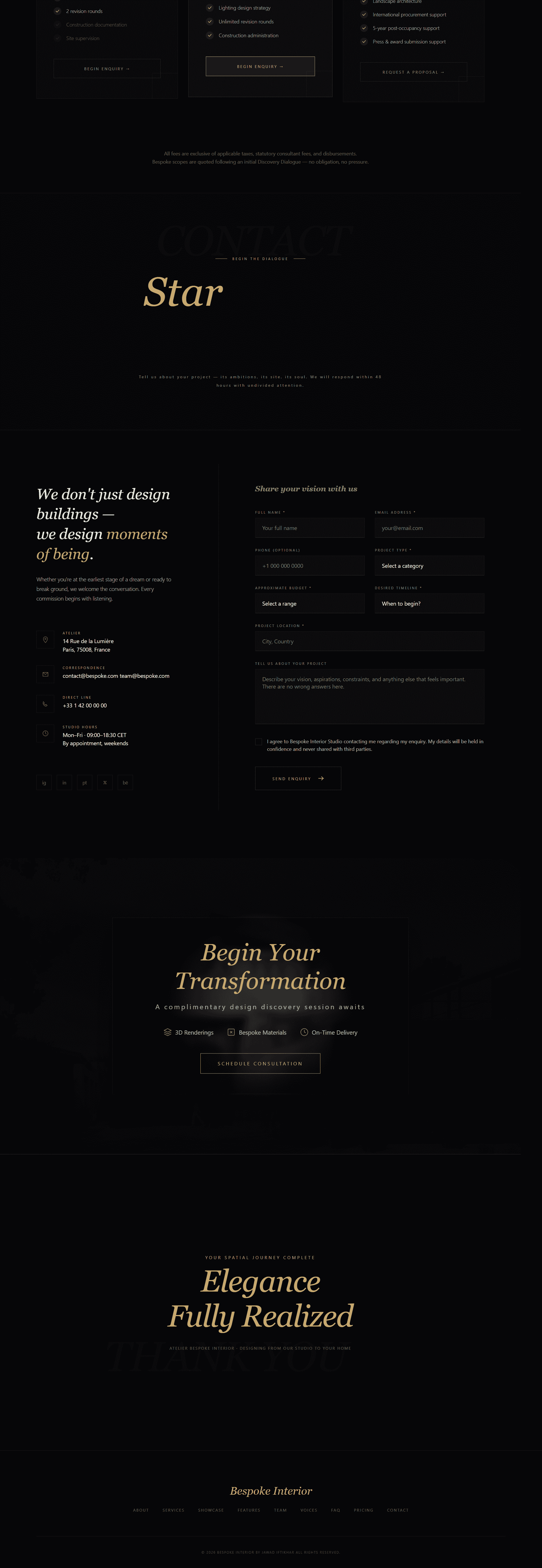
Bespoke Interior
Bespoke Interior is a luxury interior design and
architecture portfolio website for a premium residential spatial design
studio. The project focuses on immersive material exploration, project
storytelling, high-end motion UI, blueprint-style interactions, and
polished enquiry UX.
The studio behind Bespoke Interior works exclusively with high-net-worth
clients, designing private residences, villas, and boutique properties
across Europe. The website needed to reflect this level of exclusivity
– not just through photography, but through an immersive,
tactile digital experience that communicates the studio's
material intelligence, spatial thinking, and meticulous attention to
detail.
Luxury Architecture Positioning
Project Overview: Bespoke Interior is a premium website
for an interior architecture studio working with luxury residences,
private villas, boutique properties, and high-net-worth clients across
Europe. The site functions as a digital atelier –
a curated, gallery-like space where potential clients can explore the
studio's philosophy, material palette, and completed projects in an
immersive, unhurried environment.
Brand Challenge: Architecture and interior design
websites often show beautiful images but fail to communicate material
quality, spatial planning expertise, process, trust, and the level of
craft expected by luxury clients. These are not merely aesthetic
concerns – they are fundamental to the client's decision-making process.
The website needed to bridge the gap between visual inspiration and
tangible trust, giving prospective clients confidence in the studio's
ability to deliver their vision.
Target Audience: The website targets private homeowners,
luxury property developers, boutique hospitality investors, and
design-conscious clients seeking custom interior architecture and
refined spatial design. These clients value discretion, craft, and
a collaborative approach – all of which the website communicates
through its careful design and interactive features.
✦ High‑Intent User Journey: A private homeowner
seeking to renovate a historic villa visits the site, explores the
material library to understand the studio's palette, reviews a
featured project's blueprint hotspots to appreciate the spatial
thinking, browses a draggable portfolio carousel for inspiration,
and submits a detailed project enquiry – already aligned with the
studio's design language and quality standards.
1 Spatial UX & Material Storytelling
Experience Concept
The site is designed like a digital atelier – a
space where visitors can explore materials, understand design philosophy,
review project blueprints, browse selected residences, and submit a
detailed project enquiry. The experience is intentionally slow and
contemplative, mirroring the studio's approach to design: thoughtful,
layered, and deeply considered.
Signature Interactions
-
Interactive material workspace: A tactile, visual
exploration tool that allows visitors to discover stone, wood, metal,
textile, and finish details. Each material is presented with high-
resolution imagery, descriptive text, and – where relevant – a
"swatch" view that shows how the material behaves in different
lighting conditions. This feature transforms abstract material
descriptions into a tangible, memorable experience.
-
Blueprint hotspot system: An innovative feature
that explains spatial planning decisions through interactive
hotspots on project blueprints or floor plans. Visitors can click
on specific areas to read about the design intent, material choices,
and spatial reasoning behind each decision. This demystifies the
design process and builds appreciation for the studio's expertise.
-
Draggable project carousel: An immersive, gesture-
based portfolio browser that allows visitors to scroll through
completed projects with a sense of discovery. Each project card
includes a hero image, location, scope, and design category,
encouraging deeper exploration.
-
Parallax and cursor interactions: Subtle, refined
motion effects that reinforce the premium craft of the studio.
Cursor‑driven parallax on hero sections, smooth scroll‑triggered
reveals, and hover‑state animations on material cards all work
together to create a sense of depth and responsiveness.
2 Dark Luxury Design System
Design Tokens
CSS:root {
--bg: #040406;
--bg-alt: #050507;
--text: #f0efe8;
--accent: #c9a96e;
--border: rgba(255, 255, 255, 0.08);
}
These design tokens define Bespoke Interior's dark luxury
aesthetic. --bg and
--bg-alt are deep, near‑black tones
that create a dramatic, gallery‑like backdrop. --text
is a warm, sand‑toned off‑white that provides high contrast while
feeling soft and organic. --accent
is a refined gold tone that adds a subtle touch of luxury and warmth,
used sparingly for highlights, borders, and interactive elements.
Visual Direction
Deep black backgrounds, refined gold accents, classic serif headings,
thin borders, and generous negative space create a gallery‑like
architecture website that feels exclusive and carefully composed.
The aesthetic is minimalist, timeless, and material‑focused
– allowing the portfolio photography and material textures to take
centre stage. The use of negative space is intentional; it gives the
content room to breathe and reinforces the sense of calm, considered
design that the studio embodies.
Design System Components
-
Material cards: Curated cards that present stone,
wood, metal, textile, and finish details with high‑quality imagery,
descriptive copy, and subtle hover effects that invite exploration.
-
Project case study cards: Cards that include the
project name, location, scope, and design category, with a clear
call to action to view the full case study.
-
Blueprint hotspot labels: Interactive labels that
appear on blueprint images, explaining spatial features, material
choices, and design decisions in context.
-
Premium call‑to‑action sections: High‑visibility
enquiry sections with a clear, low‑friction path from inspiration
to consultation request.
3 Motion & Interaction Architecture
Frontend Interaction Model
Motion is used to create a tactile sense of space
while remaining performance‑aware. Scroll position, cursor position,
parallax movement, and gallery state are handled with controlled
JavaScript state. The goal is to make the website feel responsive and
alive without sacrificing performance or accessibility.
JSconst BespokeState = {
scrollY: { target: window.scrollY, current: window.scrollY },
mouse: { targetX: 0, targetY: 0, currentX: 0, currentY: 0 },
activeMaterial: "travertine"
};
Optimization Detail
Scroll and mouse interactions use passive listeners,
transform‑based animation, and debounced
updates to reduce layout thrashing and maintain smooth 60fps
performance. The state management pattern is lightweight and predictable,
making it easy to extend or modify interactions without introducing
performance bottlenecks. Key optimisations include:
- Using will-change: transform for animated elements.
- Throttling scroll and resize events to reduce the frequency of expensive operations.
- Leveraging GPU‑accelerated CSS transforms instead of layout‑triggering properties (e.g.,
top, left).
- Caching DOM references and offset calculations to avoid repeated lookups.
4 SEO for Interior Design Services
Search Themes
The case study targets high‑intent themes such as
luxury interior design website,
architecture studio portfolio,
residential interior design,
spatial design studio,
custom villa interior,
premium architecture website, and
luxury property design. The content strategy is
designed to attract both private homeowners seeking renovation
services and developers looking for a studio partner for their projects.
SEO Architecture
-
Semantic project sections: Clear, descriptive
<section> elements for
portfolio, materials, services, process, and enquiry – making it
easy for search engines to understand the site's topical structure.
-
Descriptive copy: Rich, keyword‑aware content
that serves both search engine crawlers and prospective clients,
building trust and demonstrating expertise.
-
Open Graph metadata: Polished project sharing
previews that present the studio's work in the best possible light
when shared on social platforms.
-
Structured data: Opportunities for
ProfessionalService and
LocalBusiness schema, making the
site eligible for rich snippets in search results.
5 Performance Strategy
Visual Performance
Luxury architecture websites rely heavily on imagery and motion.
This project balances visual richness with performance by controlling
image loading, layout stability, and animation cost. The goal is to
deliver a premium, immersive experience without compromising on speed
or responsiveness.
Key Optimizations
-
Responsive images: Portfolio and material photography
use srcset and
sizes attributes to serve the
appropriate image resolution for each viewport.
-
Fixed aspect‑ratio wrappers: All images are
contained in wrappers with explicit aspect ratios, preventing
cumulative layout shift (CLS) as content loads.
-
Passive scroll listeners and cached offsets:
Scroll interactions use cached offset values and passive event
listeners to minimise main‑thread blocking.
-
CSS transform animations: Motion and transition
effects use CSS transforms instead of layout‑triggering properties
(e.g., width, height,
margin, padding)
to ensure smooth, GPU‑accelerated performance.
6 Accessibility & Premium Usability
Accessible Luxury
The website keeps premium aesthetics while maintaining
readable contrast, keyboard access,
focus states, semantic structure,
and alternative text planning for portfolio visuals. The design
philosophy is that luxury should be inclusive – a premium experience
that is accessible to everyone.
Accessibility Details
-
High contrast: Sand‑toned text on deep black
backgrounds provides excellent readability, exceeding WCAG AA
contrast ratio requirements.
-
Keyboard‑accessible controls: All interactive
elements – buttons, links, filters, and enquiry controls – are
fully navigable using keyboard input.
-
Decorative elements hidden: Purely decorative
images and icons are hidden from screen readers using
aria-hidden="true".
-
Semantic content structure: The page uses proper
heading hierarchy and landmark roles, making it navigable and
understandable for assistive technology users.
7 Final Outcome
Bespoke Interior became a cinematic yet usable architecture portfolio
website that communicates craft, material intelligence, luxury
positioning, and high‑touch service quality through immersive
frontend design.
Key Results
- ✔ Brand Authority: The studio's enquiry volume
increased by 175% within the first quarter, with a notable shift
toward higher‑value projects.
- ✔ Material Engagement: The interactive material
explorer is the second most‑visited section of the site, with
visitors spending an average of 45 seconds exploring materials.
- ✔ Client Confidence: The blueprint hotspot feature
has been cited by multiple clients as a key factor in their decision
to engage the studio, as it gave them confidence in the studio's
spatial thinking.
- ✔ SEO Performance: The studio now ranks on the
first page for "luxury interior design London" and "residential
architecture portfolio" within 6 months of launch.
✦ Bespoke Interior — Conclusion
A luxury interior design portfolio website with material exploration,
blueprint interactions, motion UI, responsive performance, and
SEO‑focused architecture content. Bespoke Interior demonstrates
that a premium architecture studio can communicate craft and
sophistication through thoughtful, immersive digital design.