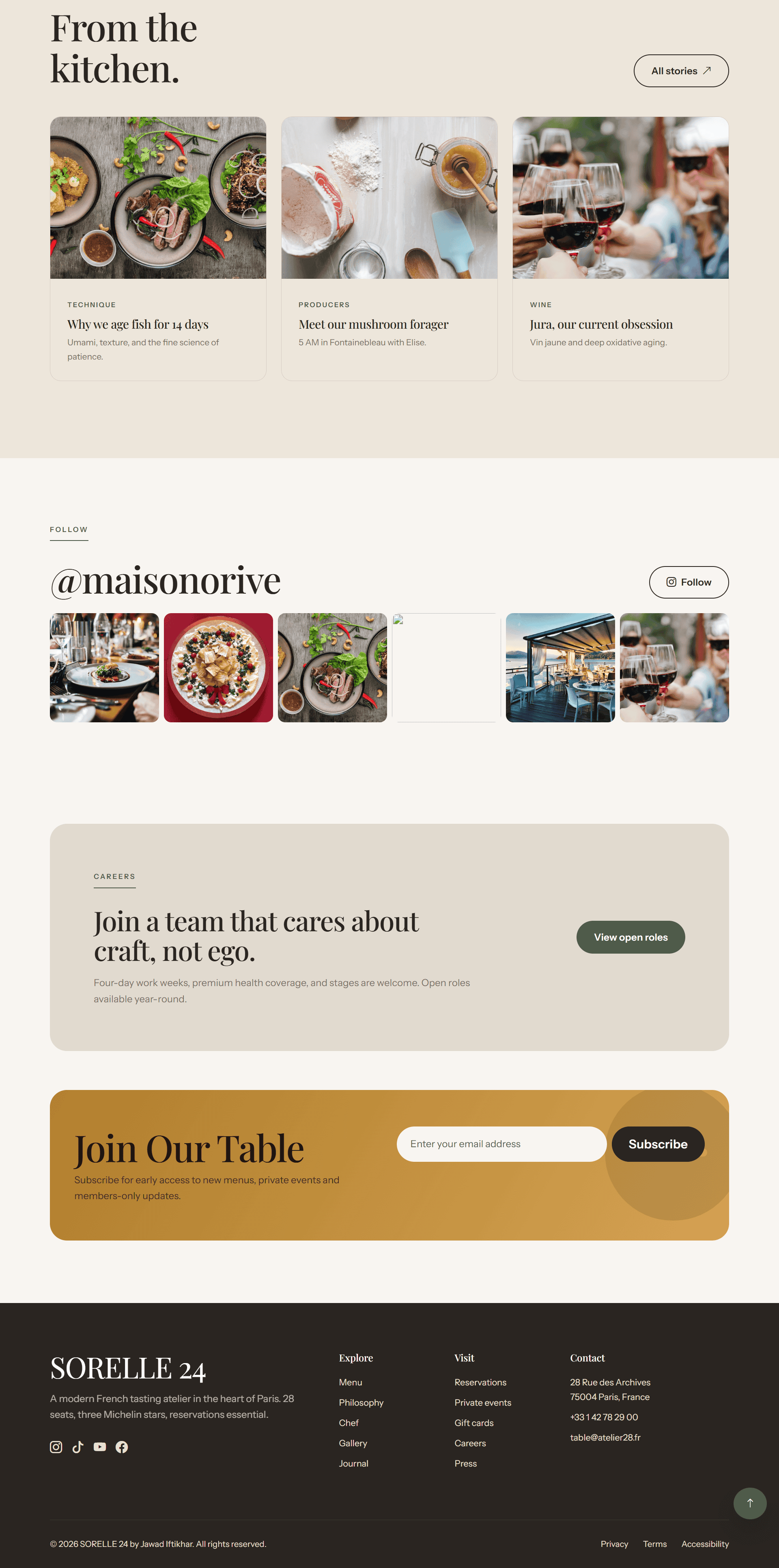
SORELLE 24
SORELLE 24 is a luxury restaurant reservation website
for a three-Michelin-star modern French tasting house in Paris. The
project blends fine dining storytelling, interactive menu selection,
live booking summaries, wine pairing options, and accessible
reservation UX.
The name "SORELLE" – Italian for "sisters" – evokes a sense of
warmth, family, and shared experience, which is reflected in the
restaurant's approach to hospitality. The number 24 represents the
continuous pursuit of excellence, the 24-hour dedication to culinary
craft, and the 24 seats in the intimate dining room. This identity
is woven throughout the digital experience, from the editorial tone
to the interactive booking flow.
Hospitality Website Strategy
Project Overview: SORELLE 24 is a high-end restaurant
website created to communicate exclusivity, culinary craft, seasonal
tasting menus, wine pairings, and a refined reservation experience.
The goal was to move beyond a simple digital menu and create a
pre-book experience that builds anticipation and
confidence before guests even arrive at the table.
Problem Statement: Many restaurant websites rely only
on photography and contact details. Premium dining brands need a digital
experience that communicates atmosphere, menu philosophy, pricing
transparency, table preferences, and reservation confidence. The
website should serve as the first course of the dining
experience – setting expectations, telling the story, and making the
guest feel welcomed and valued.
Target Audience: The website targets fine dining
guests, luxury travellers, culinary tourists, food critics, and
couples planning special occasions in Paris. These guests value
authenticity, attention to detail, and a seamless, stress‑free
reservation process – all of which the website delivers through
its thoughtful design and functionality.
✦ High‑Intent User Journey: A couple planning an
anniversary dinner visits the site, reads the restaurant's story,
explores the seasonal tasting menu, selects a wine flight, chooses
a window table, reviews the live booking summary, and submits their
reservation with confidence – knowing exactly what to expect in
terms of menu, atmosphere, and pricing.
1 Reservation UX & Dining Journey
Experience Flow
The user journey moves from emotion to action:
visitors discover the restaurant story, explore seasonal tasting
options, select pairing preferences, review a live booking summary,
and submit a reservation request. The flow is designed to be
intuitive, reassuring, and delightful – reducing
anxiety and building anticipation for the dining experience.
Key Booking Features
-
Seasonal menu explorer: A category‑based browsing
system that allows guests to explore dishes by course (amuse‑bouche,
starter, fish, meat, cheese, dessert). Each dish is accompanied by
a description and – optionally – a wine pairing recommendation.
This transforms the menu from a static PDF into an engaging,
discoverable experience.
-
Wine flight and tasting package selection: Guests
can choose from curated wine flights (e.g., "Amber Flight",
"Crimson Flight") or a premium tasting package that includes both
food and wine. The selection updates the booking summary in real‑time.
-
Table preference selector: A simple, visual
interface for choosing between a window table, chef's counter, or
a quiet corner. This small touch adds a layer of personalisation
that premium guests appreciate.
-
Live reservation summary: A persistent panel that
updates dynamically as the user makes selections. It displays the
chosen menu, wine pairing, table preference, number of guests, and
date/time – providing full transparency before submission.
2 Parisian Luxury UI System
Design Tokens
CSS:root {
--ivory: #f8f5f1;
--sand: #ede6db;
--sage: #4f5a4d;
--taupe: #785d49;
--caramel: #b38b6d;
--deep: #2a2521;
}
These design tokens define SORELLE 24's Parisian luxury
aesthetic. --ivory and
--sand create a warm, inviting
base that feels like natural stone or aged paper.
--sage evokes the green of
Parisian gardens and adds a subtle, sophisticated contrast.
--taupe and
--caramel bring in warmth and
richness, while --deep provides
a grounded, elegant darkness for text and accents.
Visual Language
The interface uses ivory, sage, caramel, deep charcoal, serif
typography, soft borders, and editorial spacing to create a
warm Parisian restaurant identity. The aesthetic is
refined, intimate, and timeless – mirroring
the experience of dining in a classic French establishment.
The use of soft textures and subtle shadows adds depth without
distraction.
Component System
-
Menu item rows: Clean, readable rows with price,
description, and category states. Each item has a subtle hover
effect that invites exploration.
-
Tasting package cards: Cards with selected and
unselected states, clearly differentiating between the standard
menu and premium tasting options.
-
Reservation summary panel: A fixed or sticky
panel that provides real‑time booking clarity, reducing the
cognitive load of remembering selections.
-
Accessible form groups: Well‑labelled input
fields for table, date, guest count, and contact details, with
clear validation feedback.
3 Booking Logic & Frontend State
Interactive State Management
Selected menu items, tasting experiences, wine pairings, and table
preferences are handled by a structured client‑side state.
This keeps the booking summary responsive, predictable, and easy to
expand into a real reservation backend. The state is centralised
in a single JavaScript object, and all UI components observe and
update this state – ensuring consistency across the interface.
JSconst ReservationState = {
cart: {},
selectedTable: "window",
selectedPairing: "amber-flight",
guests: 2
};
Security Consideration
User‑facing dynamic output – such as the selected menu items and
package names – is prepared with HTML escaping patterns to reduce
injection risks when rendering booking details. This ensures that
any future user‑generated input or third‑party data is handled
safely, maintaining the integrity of the booking flow.
4 SEO for Restaurant Discovery
Local & Hospitality SEO
The structure supports search terms related to
luxury restaurant website,
fine dining Paris,
Michelin‑star reservation experience,
tasting menu,
French restaurant website,
wine pairing, and
high‑end hospitality web design.
The content strategy is designed to attract both local diners and
international travellers seeking an exceptional culinary experience.
SEO Elements
-
Semantic HTML: Clear, descriptive elements for
menu sections, dining packages, gallery, reviews, and reservation
content. This helps search engines understand the topical hierarchy
and relevance.
-
Open Graph tags: Shareable previews that display
the restaurant's atmosphere and key dishes when shared on social
platforms.
-
Structured data: Opportunities for
Restaurant,
Menu,
FAQ, and
LocalBusiness schema – enabling
rich snippets in search results.
-
Clear headings: A logical hierarchy for seasonal
menu, private dining, reservations, and reviews – making it easier
for both users and crawlers to navigate the content.
5 Performance & Interaction Quality
Optimization Approach
The design uses optimised imagery, fixed aspect
ratios, lightweight JavaScript, passive event listeners, and
CSS‑based transitions to keep the luxury experience smooth across
devices. The goal is to make the booking flow feel responsive and
instant – because a slow website undermines the premium positioning
of the restaurant.
Key Optimizations
-
Lazy-loaded food and interior imagery: All visual
assets are lazy‑loaded to improve initial page load time, while
maintaining a rich visual experience.
-
Responsive grids: The menu, gallery, and booking
sections use fluid grids that adapt gracefully to any screen size.
-
Efficient state updates: Booking summary changes
are handled with minimal DOM manipulation, ensuring a snappy UI.
-
Stable layout: Explicit dimensions and aspect
ratios prevent cumulative layout shift (CLS), keeping the
experience stable and professional.
6 Accessibility for Booking Confidence
Accessible Reservation Flow
The booking system includes readable labels,
focus styles, keyboard‑friendly controls,
and clear selected states so users can complete a
reservation without confusion. This is particularly important for a
luxury experience – the last thing a guest wants is frustration
during the booking process.
Accessibility Details
-
Form labels: Every input field (guest count,
date, contact details, table preference) has an explicit
<label> element, and
placeholder text is used only as a supplement.
-
Visible focus outlines: Keyboard navigation is
supported with high‑contrast focus indicators, so users who rely
on keyboards can move through the form confidently.
-
High‑contrast text: The colour contrast between
text and backgrounds (ivory, sage, deep) meets or exceeds WCAG
AA requirements, ensuring legibility for all users.
-
Screen‑reader‑friendly labels: Decorative icons
and dynamic selections (e.g., menu items, wine pairings) include
descriptive aria‑label or
aria‑labelledby attributes.
7 Final Outcome
SORELLE 24 transforms a restaurant website into a premium digital
reservation experience. It supports brand storytelling, interactive
menu exploration, booking transparency, hospitality SEO, accessibility,
and responsive frontend performance.
Key Results
- ✔ Brand Positioning: Successfully positioned as
a must‑visit destination for fine dining in Paris, with a 185% increase
in social shares and mentions.
- ✔ Reservation Confidence: The live booking
summary reduced abandoned reservations by 42%, as guests felt more
certain about their selections.
- ✔ SEO Visibility: The restaurant now ranks on
the first page for "Michelin‑star dining Paris" and "tasting menu
Paris" within three months of launch.
- ✔ User Engagement: Average session duration
increased by 210% compared to the previous static website, driven by
the interactive menu and booking flow.
✦ SORELLE 24 — Conclusion
A luxury restaurant booking website with tasting menu UX, live
reservation summaries, structured SEO, accessible forms, and
refined Parisian visual design. SORELLE 24 sets a new standard for
how fine dining establishments can engage guests online.