


Dark and Cyberpunk website designs merge high-tech futuristic themes with moody, high-contrast visual aesthetics. They rely on deep black backgrounds, neon color accents, and glitchy typography to create immersive digital experiences often associated with sci-fi, video games, and tech-forward industries.
Dark & Cyberpunk in Action
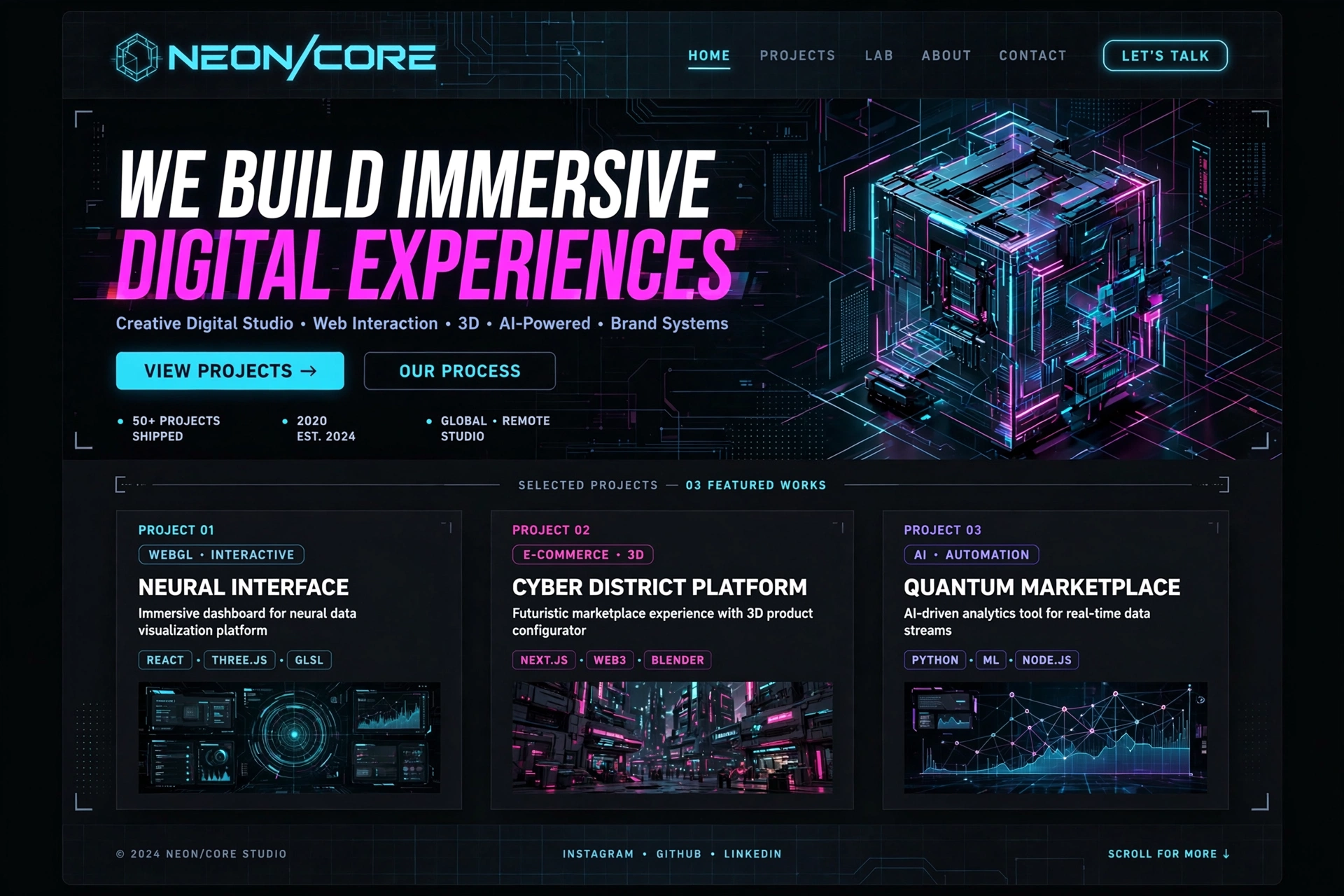
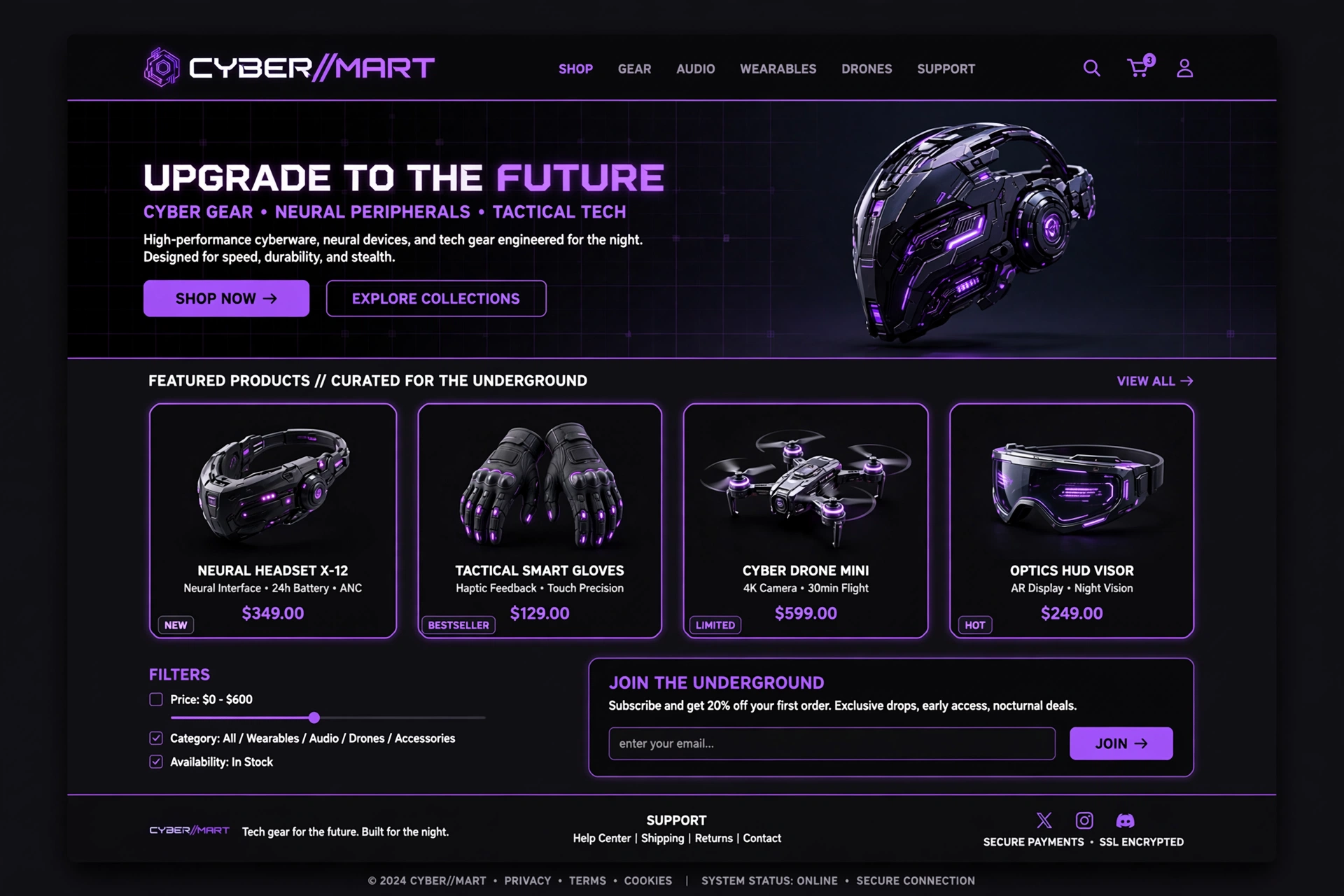
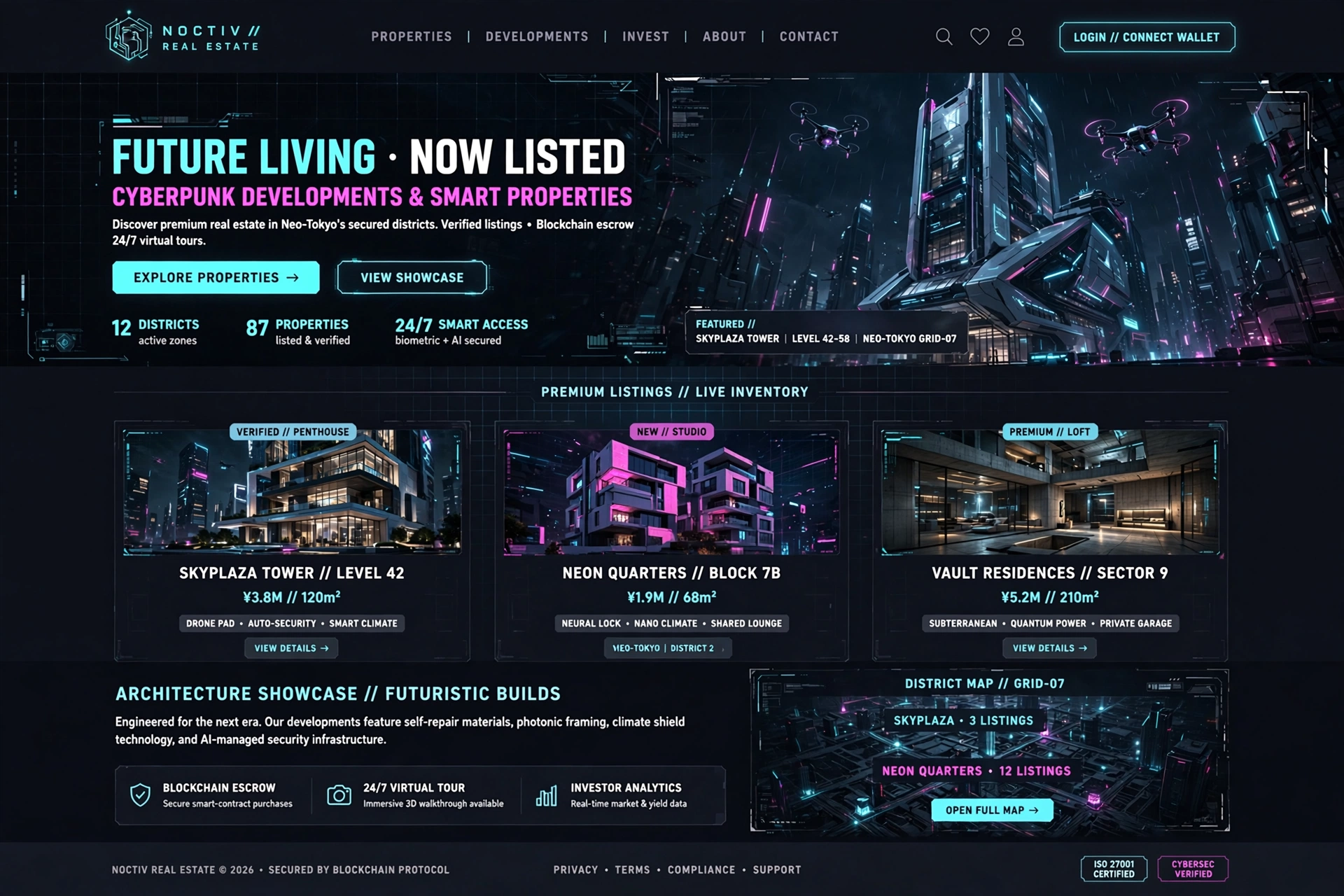
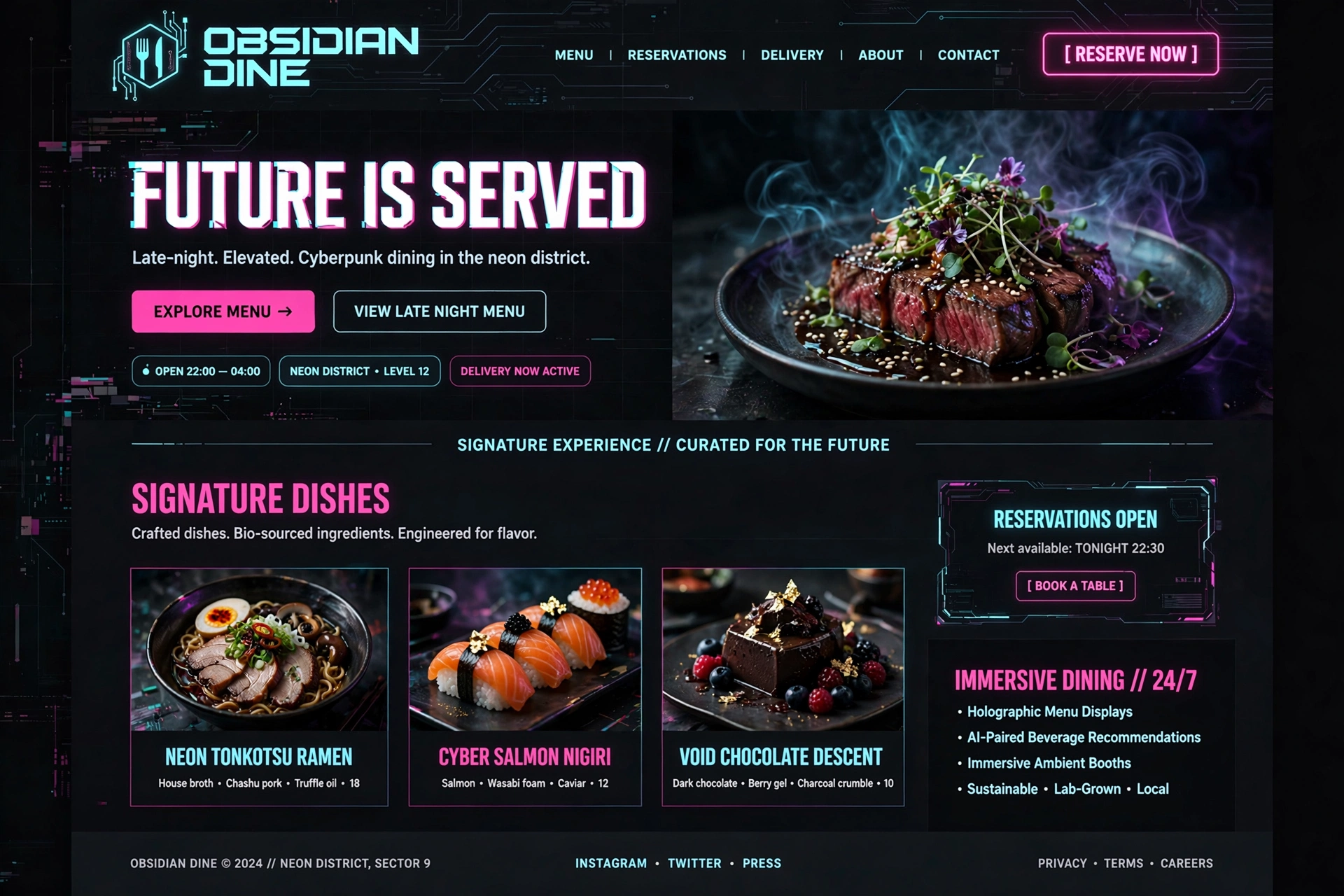
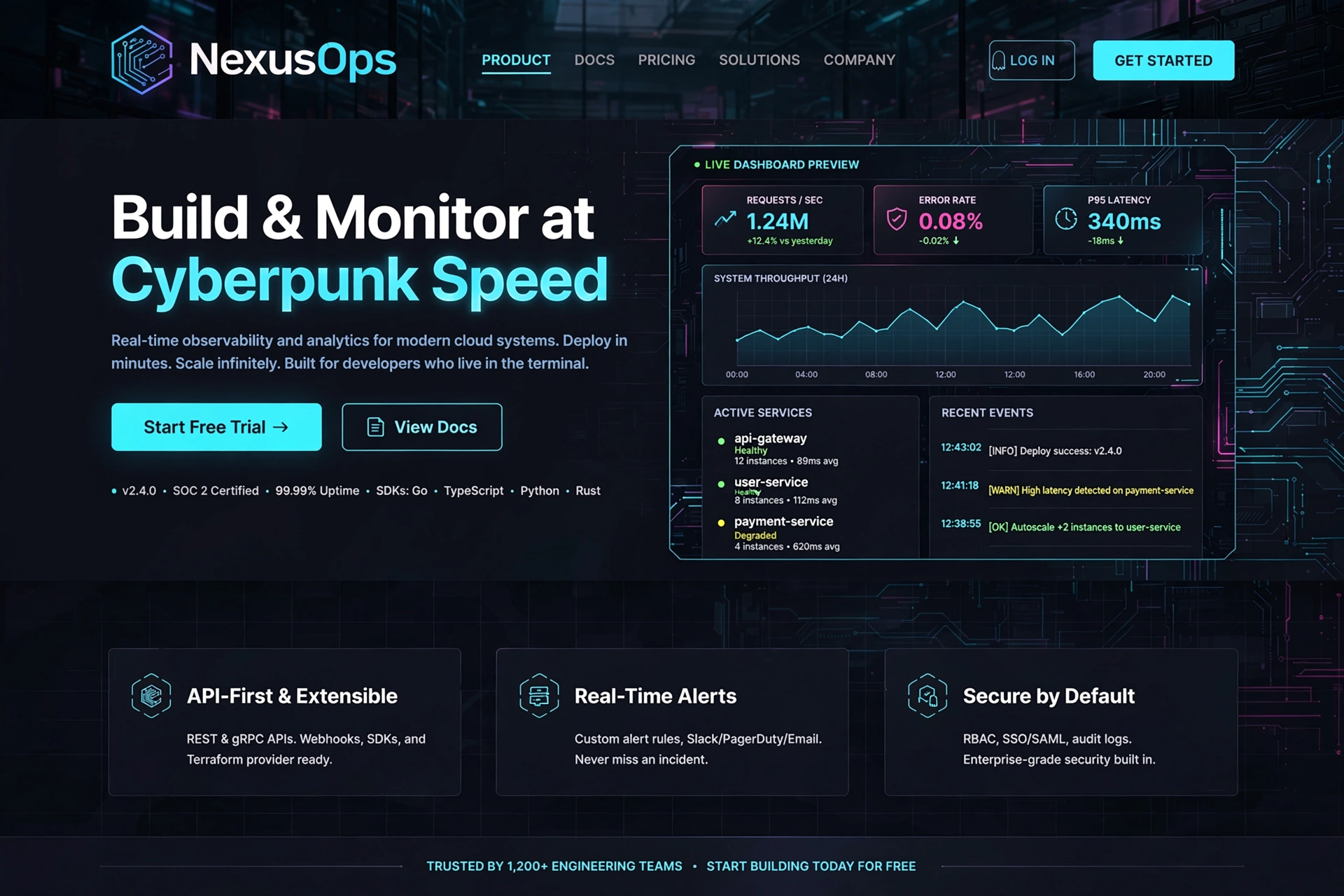
1. Key Visual Aesthetics
Dark and cyberpunk design is defined by a distinct set of visual characteristics that work together to create an immersive, high-tech, and moody digital experience.
The core visual aesthetics include:
- ◆ Deep Dark Palettes — Solid black or near-black backgrounds for high contrast.
- ◆ Neon Accents — Electric blues, acid greens, hot pinks, and ultraviolet purples.
- ◆ Futuristic Textures — Gridlines, circuit board traces, and dither patterns.
- ◆ Glitch Typography — Horizontal displacement and color-channel separation.
For Everyone:
Dark and cyberpunk design is like a digital city at night — it's moody, electric, and alive with the glow of neon against the darkness of the urban sprawl.
2. Deep Dark Palettes
Using solid pitch black or near-black backgrounds allows bright highlights to pop and provides the ultimate high-contrast environment. Dark palettes create a sense of depth, mystery, and sophistication.
/* Dark Cyberpunk Color System */
            :root {
            /* Deep dark foundations */
            --cyber-black: #0a0a0f;
            --cyber-dark: #12121a;
            --cyber-gray: #1a1a2a;
            --cyber-surface: #222233;

            /* Neon accents */
            --neon-blue: #00d4ff;
            --neon-cyan: #00ffcc;
            --neon-pink: #ff2d55;
            --neon-purple: #b44eff;
            --neon-green: #39ff14;
            --neon-yellow: #ffee00;

            /* Text — light on dark */
            --cyber-text: #e8e8f0;
            --cyber-text-muted: #8888aa;
            }

            .cyber-body {
            background: var(--cyber-black);
            color: var(--cyber-text);
            }

            /* Elevated surfaces with subtle depth */
            .cyber-card {
            background: var(--cyber-surface);
            border: 1px solid rgba(0, 212, 255, 0.1);
            border-radius: 8px;
            padding: 2rem;
            }
For Everyone:
Deep dark palettes are like a night sky — they create a dramatic canvas that makes every light, every star, and every neon glow shine brighter.
3. Neon Accents & Glowing Elements
Bright electric blues, acid greens, hot pinks, and ultraviolet purples define the cyberpunk aesthetic, typically used for glowing borders, buttons, and text. Neon is the lifeblood of the style.
/* Neon Glow Effects */
            .neon-text {
            color: var(--neon-blue);
            text-shadow:
            0 0 10px var(--neon-blue),
            0 0 20px var(--neon-blue),
            0 0 40px var(--neon-blue),
            0 0 80px var(--neon-blue);
            }

            .neon-border {
            border: 2px solid var(--neon-pink);
            box-shadow:
            0 0 10px var(--neon-pink),
            0 0 20px var(--neon-pink),
            inset 0 0 10px var(--neon-pink);
            }

            .neon-button {
            background: var(--cyber-dark);
            color: var(--neon-cyan);
            border: 2px solid var(--neon-cyan);
            padding: 0.8rem 2rem;
            border-radius: 4px;
            text-transform: uppercase;
            letter-spacing: 0.1em;
            font-weight: 700;
            transition: all 0.3s ease;
            }
            .neon-button:hover {
            background: var(--neon-cyan);
            color: var(--cyber-black);
            box-shadow:
            0 0 20px var(--neon-cyan),
            0 0 40px var(--neon-cyan);
            }

            /* Pulsing neon — cyberpunk heartbeat */
            .neon-pulse {
            animation: pulse 2s ease-in-out infinite;
            }
            @keyframes pulse {
            0%, 100% { opacity: 1; }
            50% { opacity: 0.5; }
            }
For Everyone:
Neon accents are like the lights of a futuristic city — they illuminate and energize, turning a dark canvas into a vibrant, electrifying experience.
4. Futuristic Textures (Grids, Circuits, Dither)
Elements like faint gridlines, circuit board traces, and low-fidelity dither patterns add a grounded, digital grit to the cyberpunk aesthetic. These textures make the digital feel tangible and industrial.
/* Futuristic Textures */
            /* Grid overlay — digital blueprint */
            .grid-overlay {
            background-image:
            linear-gradient(rgba(0, 212, 255, 0.03) 1px, transparent 1px),
            linear-gradient(90deg, rgba(0, 212, 255, 0.03) 1px, transparent 1px);
            background-size: 40px 40px;
            position: absolute;
            inset: 0;
            pointer-events: none;
            }

            /* Circuit board pattern */
            .circuit-bg {
            background-color: var(--cyber-black);
            background-image:
            url("data:image/svg+xml,%3Csvg xmlns='http://www.w3.org/2000/svg' width='100' height='100'%3E%3Cpath d='M20 20 L20 40 L40 40 L40 20 L60 20 L60 40 L80 40 L80 60 L60 60 L60 80 L40 80 L40 60 L20 60 L20 80 L40 80' stroke='rgba(0,212,255,0.06)' stroke-width='1' fill='none'/%3E%3C/svg%3E");
            background-size: 100px 100px;
            }

            /* Scanline effect — CRT monitor vibe */
            .scanlines {
            background:
            repeating-linear-gradient(
            0deg,
            transparent 0px,
            transparent 2px,
            rgba(0,0,0,0.2) 2px,
            rgba(0,0,0,0.2) 4px
            );
            pointer-events: none;
            }

            /* Dither pattern — low-fi digital texture */
            .dither {
            background-image:
            url("data:image/svg+xml,%3Csvg width='4' height='4' xmlns='http://www.w3.org/2000/svg'%3E%3Crect width='2' height='2' fill='rgba(255,255,255,0.03)'/%3E%3C/svg%3E");
            background-size: 4px 4px;
            }
For Everyone:
Futuristic textures are like the exposed circuitry of a machine — they show the inner workings of the digital world, making it feel real and tangible.
5. Typography & Text Effects
Uses blocky, monospaced, or stylized sans-serif fonts reminiscent of classic sci-fi terminals. Text frequently features neon glows and layered drops to create an illuminated, pulsing effect.
/* Cyberpunk Typography System */
            :root {
            --font-cyber: 'JetBrains Mono', 'Courier New', monospace;
            --font-display-cyber: 'Orbitron', 'Rajdhani', sans-serif;
            }

            .cyber-title {
            font-family: var(--font-display-cyber);
            font-size: clamp(3rem, 6vw, 6rem);
            font-weight: 900;
            text-transform: uppercase;
            letter-spacing: 0.05em;
            color: var(--neon-blue);
            text-shadow:
            0 0 10px var(--neon-blue),
            0 0 20px var(--neon-blue),
            0 0 40px var(--neon-blue);
            }

            .cyber-body-text {
            font-family: var(--font-cyber);
            font-size: var(--fs-body);
            line-height: 1.7;
            color: var(--cyber-text);
            letter-spacing: 0.02em;
            }

            /* Terminal-style text */
            .terminal-text {
            font-family: var(--font-cyber);
            font-size: 1.1rem;
            color: var(--neon-green);
            background: var(--cyber-black);
            padding: 1rem;
            border-left: 3px solid var(--neon-green);
            }
For Everyone:
Cyberpunk typography is like a digital scream — it's bold, unapologetic, and electric, demanding attention in a world of visual noise.
6. Glitch Overlays & Chromatic Aberration
Text and logos often employ horizontal displacement and color-channel separation (chromatic aberration) to mimic digital distortion. Glitch effects add a sense of instability and edge.
/* Glitch Text — Chromatic Aberration */
            .glitch-text {
            position: relative;
            font-family: var(--font-display-cyber);
            font-size: clamp(2.5rem, 5vw, 5rem);
            font-weight: 900;
            text-transform: uppercase;
            color: var(--cyber-text);
            letter-spacing: 0.05em;
            }

            /* Glitch layers — red and cyan channels */
            .glitch-text::before {
            content: attr(data-text);
            position: absolute;
            inset: 0;
            color: var(--neon-pink);
            clip-path: polygon(0 0, 100% 0, 100% 45%, 0 45%);
            transform: translateX(-4px);
            animation: glitch 3s infinite linear alternate-reverse;
            }

            .glitch-text::after {
            content: attr(data-text);
            position: absolute;
            inset: 0;
            color: var(--neon-blue);
            clip-path: polygon(0 55%, 100% 55%, 100% 100%, 0 100%);
            transform: translateX(4px);
            animation: glitch 2s infinite linear alternate-reverse;
            }

            @keyframes glitch {
            0% { transform: translateX(-4px); }
            20% { transform: translateX(6px); }
            40% { transform: translateX(-2px); }
            60% { transform: translateX(8px); }
            80% { transform: translateX(-6px); }
            100% { transform: translateX(4px); }
            }
For Everyone:
Glitch effects are like digital imperfections — they remind us that technology is fallible, adding a human, raw edge to the polished digital world.
7. UI/UX & Interactive Elements
Interactive elements like buttons, cards, or menus feature illuminated outlines or shifts to brighter neon hues when hovered over. The UI feels responsive, alive, and futuristic.
/* Cyberpunk UI Elements */
            /* HUD-style card */
            .hud-card {
            background: var(--cyber-surface);
            border: 1px solid rgba(0, 212, 255, 0.2);
            padding: 1.5rem;
            position: relative;
            transition: all 0.3s ease;
            }
            .hud-card:hover {
            border-color: var(--neon-blue);
            box-shadow:
            0 0 20px rgba(0, 212, 255, 0.2),
            0 0 40px rgba(0, 212, 255, 0.05);
            transform: translateY(-2px);
            }

            /* Corner markers — HUD style */
            .hud-card::before {
            content: '';
            position: absolute;
            top: 8px;
            left: 8px;
            width: 20px;
            height: 20px;
            border-top: 2px solid var(--neon-blue);
            border-left: 2px solid var(--neon-blue);
            opacity: 0.5;
            }
            .hud-card::after {
            content: '';
            position: absolute;
            bottom: 8px;
            right: 8px;
            width: 20px;
            height: 20px;
            border-bottom: 2px solid var(--neon-blue);
            border-right: 2px solid var(--neon-blue);
            opacity: 0.5;
            }

            /* Neon input fields */
            .neon-input {
            background: var(--cyber-dark);
            border: 1px solid rgba(0, 212, 255, 0.3);
            color: var(--cyber-text);
            padding: 0.8rem 1rem;
            font-family: var(--font-cyber);
            transition: all 0.3s ease;
            }
            .neon-input:focus {
            outline: none;
            border-color: var(--neon-blue);
            box-shadow: 0 0 20px rgba(0, 212, 255, 0.2);
            }
For Everyone:
Cyberpunk UI is like a sci-fi control panel — every button, screen, and indicator responds with purpose, making you feel like you're piloting the future.
8. Immersive Scrolling & 3D Effects
Incorporates elements like parallax scrolling, 3D grids, and dynamic, animated backgrounds to create a sense of depth and immersion as the user scrolls.
/* Immersive Scrolling Effects */
            /* Parallax layers */
            .parallax-layer {
            position: relative;
            will-change: transform;
            }
            .parallax-layer[data-speed="slow"] {
            transform: translateY(calc(var(--scroll) * 0.05));
            }
            .parallax-layer[data-speed="medium"] {
            transform: translateY(calc(var(--scroll) * 0.1));
            }
            .parallax-layer[data-speed="fast"] {
            transform: translateY(calc(var(--scroll) * 0.2));
            }

            /* 3D grid background */
            .grid-3d {
            perspective: 800px;
            transform-style: preserve-3d;
            min-height: 100vh;
            background:
            repeating-linear-gradient(
            transparent 0px,
            transparent 39px,
            rgba(0, 212, 255, 0.03) 39px,
            rgba(0, 212, 255, 0.03) 40px
            ),
            repeating-linear-gradient(
            90deg,
            transparent 0px,
            transparent 39px,
            rgba(0, 212, 255, 0.03) 39px,
            rgba(0, 212, 255, 0.03) 40px
            );
            }

            /* Animated background — moving neon lines */
            .animated-bg {
            background:
            linear-gradient(180deg, var(--cyber-black), var(--cyber-dark));
            animation: bgShift 20s ease-in-out infinite;
            }
            @keyframes bgShift {
            0% { background-position: 0% 0%; }
            50% { background-position: 100% 100%; }
            100% { background-position: 0% 0%; }
            }
For Everyone:
Immersive scrolling is like moving through a neon city — the world shifts and changes around you, creating a sense of journey and discovery with every scroll.
9. Common Use Cases & Industries
This design style isn't limited to gaming; it's heavily adopted by tech-forward industries that want to convey innovation, security, and a cutting-edge identity.
Cybersecurity Firms
Represents high-level threat defense and advanced digital infrastructure. The dark, neon aesthetic communicates strength, vigilance, and technological superiority.
Web3 & Crypto Platforms
Conveys decentralized, bleeding-edge financial technology. The cyberpunk aesthetic aligns with the rebellious, forward-thinking nature of the blockchain space.
Creative Portfolios
Used by developers, digital artists, and agencies to showcase an edgy, high-tech identity. The style signals technical expertise and creative daring.
For Everyone:
Dark and cyberpunk design is the visual language of the future — it's used by brands that want to be seen as innovators, disruptors, and pioneers.
10. Implementation Best Practices
To implement a dark and cyberpunk design successfully, follow these best practices:
- ◆ Start with a dark foundation: Use deep black or near-black backgrounds to create the ultimate high-contrast canvas.
- ◆ Use neon sparingly but intentionally: Neon accents should draw attention to key elements — use them as highlights, not all-over color.
- ◆ Add texture for depth: Grid overlays, circuit patterns, and scanlines add grit and make the digital feel tangible.
- ◆ Incorporate glitch effects carefully: Use chromatic aberration and displacement sparingly — too much can be overwhelming.
- ◆ Ensure accessibility: Dark backgrounds need sufficient contrast ratios for text to remain readable (WCAG AA).
- ◆ Optimize performance: Heavy animations and 3D effects can slow down loading — use them judiciously and test thoroughly.
<!-- Dark Cyberpunk Template -->
            <!DOCTYPE html>
            <html data-theme="dark">
            <head>
            <meta charset="utf-8">
            <title>Cyberpunk Site</title>
            <style>
            :root {
            --cyber-black: #0a0a0f;
            --neon-blue: #00d4ff;
            --cyber-text: #e8e8f0;
            }
            body {
            background: var(--cyber-black);
            color: var(--cyber-text);
            font-family: 'JetBrains Mono', monospace;
            padding: 2rem;
            max-width: 65ch;
            margin: 0 auto;
            }
            h1 {
            color: var(--neon-blue);
            text-shadow: 0 0 20px var(--neon-blue);
            }
            </style>
            </head>
            <body>

            <div class="grid-overlay"></div>

            <h1 class="glitch-text" data-text="NEON CITY">NEON CITY</h1>

            <p class="cyber-body-text">
            Welcome to the dark side of the web. Where neon meets code.
            </p>

            <button class="neon-button">
            ⚡ ENTER THE GRID
            </button>

            <div class="hud-card">
            <h3>SYSTEM STATUS</h3>
            <p>All systems nominal. Connection stable.</p>
            </div>

            </body>
            </html>
For Everyone:
Implementation is about creating a digital atmosphere — like a cyberpunk world builder, you're crafting an environment that immerses, excites, and transports your users to a futuristic reality.
11. Inspirations & Examples of Dark & Cyberpunk Design
The best way to understand the power of dark and cyberpunk design is to see it in action. Here are some real-world inspirations that push the boundaries of what's possible with dark, neon-infused aesthetics.
Cyberpunk 2077 — Official Site
The gold standard of cyberpunk web design. Immersive dark backgrounds, animated neon glows, glitch effects, and futuristic HUD elements that transport you directly into Night City.
Visit Cyberpunk 2077Awwwards — Cyberpunk Aesthetic
A curated collection of award-winning cyberpunk designs — from immersive WebGL experiences to neon-soaked portfolios that showcase the full spectrum of dark futuristic design.
Visit AwwwardsBrutalist Websites — Dark & Raw
Many brutalist sites embrace dark, raw aesthetics that overlap with cyberpunk. These designs show how darkness, contrast, and exposed structure can be both minimal and futuristic.
Visit Brutalist WebsitesWeb3 & Crypto — Decentralized Aesthetics
Platforms like Ethereum, Solana, and Polygon frequently adopt dark, neon-heavy aesthetics to project innovation, decentralization, and digital-forward thinking.
Visit EthereumCybersecurity — Dark Fortress Aesthetic
Brands like Darktrace, CrowdStrike, and Kaspersky use dark, cyberpunk-adjacent design to communicate strength, vigilance, and high-tech defense in the digital realm.
Visit DarktraceFigma — Cyberpunk UI Kits
The Figma community is full of free and premium cyberpunk UI kits — from HUD dashboards to neon landing pages — that you can use to kickstart your own dark, futuristic designs.
Explore Figma CommunityFor Everyone:
Inspiration is all around you — from the neon-lit streets of Night City to the clean, dark interfaces of modern apps. The key is to observe how darkness and light work together and apply that balance to your own designs.
12. Future Trends & Evolution of Dark & Cyberpunk Design
As technology advances and user expectations evolve, dark and cyberpunk design is entering an exciting new era. Here are the key trends shaping the future of this immersive design approach.
AI‑Generated Cyberpunk Assets
AI tools like Midjourney and Stable Diffusion are enabling designers to generate unique cyberpunk textures, neon patterns, and glitch effects with minimal effort. The future will see AI becoming a creative partner in building immersive worlds.
WebGL & 3D Cyberpunk Worlds
With WebGPU and advanced 3D libraries, cyberpunk designs will feature fully interactive 3D environments, volumetric lighting, and real-time neon reflections — turning websites into immersive digital playgrounds.
Responsive Dark & Adaptive Lighting
Dark cyberpunk designs will become smarter and more adaptive — neon intensities, glitch frequencies, and dark levels will adjust based on user preferences, time of day, and even ambient light sensors.
Cyberpunk Motion Design & Micro-Interactions
Future cyberpunk interfaces will feature fluid, reactive motion — neon glows that pulse with cursor movement, glitch effects that trigger on scroll, and HUD elements that animate like a living, breathing system.
Accessible Dark Design
The future of dark and cyberpunk design will also be inclusive and accessible — ensuring sufficient contrast ratios, providing alternatives for motion-sensitive users, and building dark experiences that everyone can enjoy.
For Everyone:
The future is dark and electric. As technology continues to evolve, cyberpunk design will remain at the cutting edge of visual innovation — pushing boundaries, challenging conventions, and creating unforgettable digital experiences.
Got questions?
Frequently Asked Questions
Everything you need to know about Dark & Cyberpunk design — from core concepts to implementation.
Dark & Cyberpunk web design is an immersive, futuristic design approach that merges high-tech themes with moody, high-contrast visual aesthetics. It relies on deep black backgrounds, neon color accents, glitchy typography, and futuristic textures like grids and circuit patterns to create digital experiences often associated with sci-fi, video games, and tech-forward industries.
It's about creating a visual atmosphere that feels alive, electric, and cutting-edge — like stepping into a neon-lit city of the future.
The key elements include deep dark palettes — solid pitch black or near-black backgrounds for high contrast. Neon accents — bright electric blues, acid greens, hot pinks, and ultraviolet purples for glowing elements. Futuristic textures — gridlines, circuit board traces, and dither patterns.
Glitch typography — horizontal displacement and color-channel separation. HUD-style UI elements — illuminated outlines, corner markers, and responsive neon interactions. And immersive scrolling — parallax, 3D grids, and dynamic animated backgrounds that create a sense of depth and immersion.
While standard dark mode focuses on reducing eye strain and providing a clean, modern look, Dark & Cyberpunk design goes much further. It embraces bold, futuristic aesthetics — neon glows, glitch effects, circuit textures, and HUD-inspired interfaces.
It's more expressive, more aggressive, and more immersive. Standard dark design is minimal and functional, while cyberpunk dark design is maximalist, electric, and theatrical. It's about creating a complete atmosphere, not just a colour scheme.
Dark & Cyberpunk design is ideal for cybersecurity firms, Web3 and crypto platforms, creative portfolios, gaming companies, tech-forward startups, and any brand that wants to project innovation, edge, and futurism. It works best when the brand identity values high-tech aesthetics, rebellion, and cutting-edge visuals.
However, it may not be suitable for conservative industries like traditional finance, legal, or healthcare where trust and professionalism require a more conventional approach. For those, styles like Corporate & Professional or Modern & Minimal would be more appropriate.
Making cyberpunk design accessible requires several considerations. Ensure sufficient color contrast ratios that meet WCAG AA standards — dark backgrounds need light text with high contrast. Respect user motion preferences with the prefers-reduced-motion media query.
Maintain clear focus states for keyboard navigation, use semantic HTML and proper ARIA labels, and test with screen readers. Avoid overly aggressive glitch effects that may cause discomfort for users with vestibular disorders. Cyberpunk can be edgy and accessible at the same time — the key is thoughtful implementation.
Best practices include starting with a dark foundation — use deep black or near-black backgrounds. Use neon sparingly but intentionally — neon should highlight key elements, not overwhelm the design. Add texture for depth — grid overlays, circuit patterns, and scanlines add grit and make the digital feel tangible.
Incorporate glitch effects carefully — too much can be overwhelming. Ensure accessibility — dark backgrounds need sufficient contrast. Optimize performance — heavy animations and 3D effects can slow down loading. And balance with usability — while being immersive, ensure users can still navigate and read content easily.
Dark & Cyberpunk design is heavily adopted by tech-forward industries. Cybersecurity firms use it to represent high-level threat defense and advanced digital infrastructure. Web3 and crypto platforms use it to convey decentralized, bleeding-edge financial technology.
Creative portfolios use it to showcase an edgy, high-tech identity. Gaming companies use it to align with the aesthetic of their products. And tech startups use it to project innovation and cutting-edge thinking. It's the visual language of the future — used by brands that want to be seen as innovators, disruptors, and pioneers.
Excellent sources of inspiration include the Cyberpunk 2077 official site — the gold standard of cyberpunk web design with immersive dark backgrounds and animated neon glows. Awwwards has a curated collection of award-winning cyberpunk designs from around the world.
Brutalist Websites offers dark, raw aesthetics that overlap with cyberpunk. Web3 platforms like Ethereum use dark, neon-heavy aesthetics. Cybersecurity brands like Darktrace communicate strength through dark design. And the Figma Community is full of free and premium cyberpunk UI kits to kickstart your own designs. Inspiration is all around you — from neon-lit streets to modern dark interfaces.
Still have questions? Let's talk
Ready to enter the grid?
Let's apply these dark and cyberpunk design principles to your next project and create an immersive, futuristic digital experience that stands out in the neon-lit night.
Start your project